Why in News?
The agricultural trade surplus has reduced from $10.6 billion in April-December 2023-24 to $8.2 billion for the corresponding nine months of the current fiscal (April-March).
What is the status of international agricultural trade of India?
- India net exporter - India is a net agri-commodities exporter, with the value of its outward shipments consistently exceeding imports.
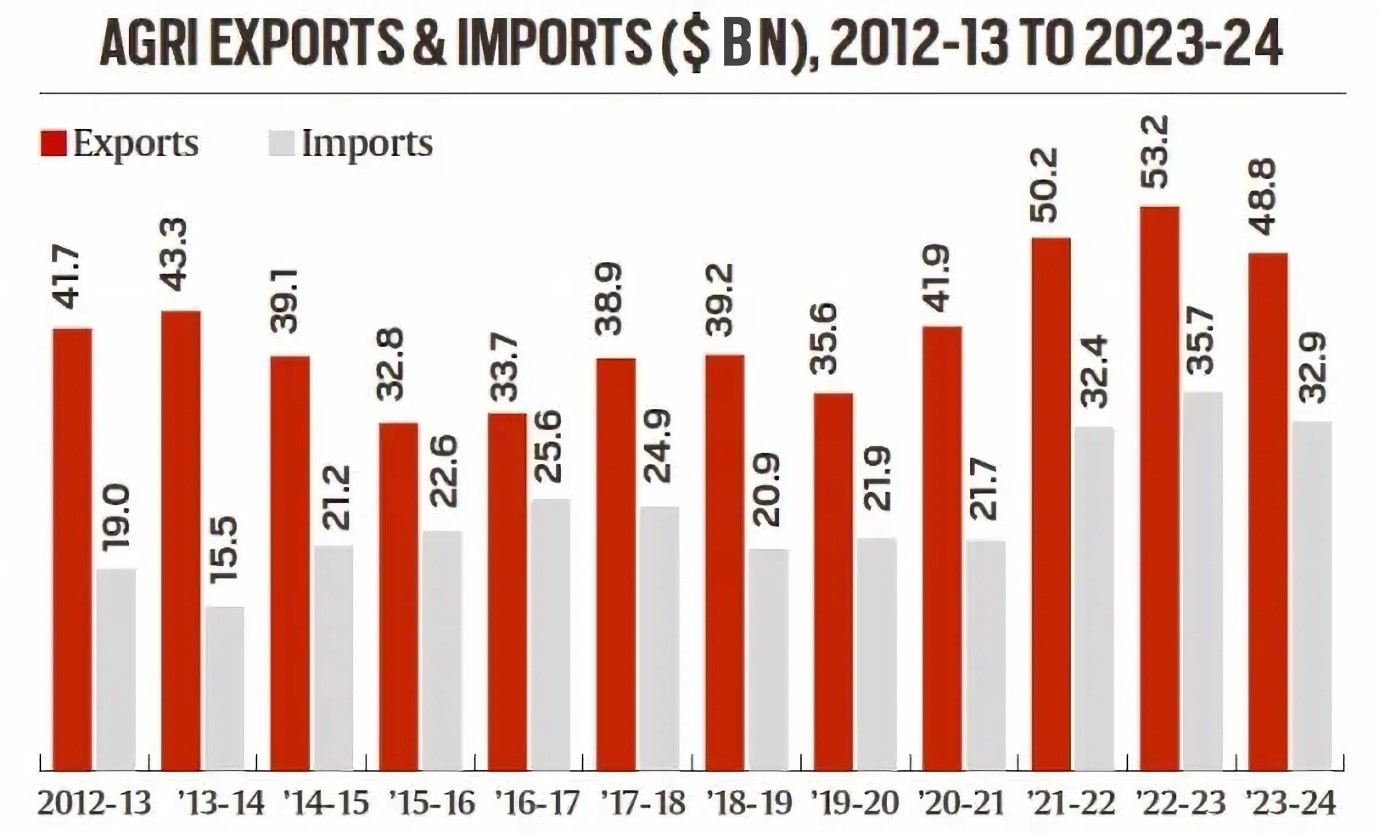
- Agri export growth - India’s agriculture exports have risen 6.5%, from $35.2 billion in April-December 2023 to $37.5 billion in April-December 2024.
- It is 1.9% more than the overall increase in the country’s merchandise exports for this period.
- Agri imports growth – Farm import has risen 18.7% (from $24.6 billion to $29.3 billion) during April-December 2024 over April-December 2023, while India’s total goods imports during were 7.4%.
- Reduction in agri trade surplus - It has reduced from $10.6 billion in April-December 2023-24 to $8.2 billion for the corresponding nine months of the current fiscal (April-March).
- Decadal trend - The trade surplus, which peaked at $27.7 billion in 2013-14, shrunk to $8.1 billion by 2016-17.
- It rose thereafter to $20.2 billion in 2020-21, before falling to $16 billion in 2023-24. It is set to further decline this fiscal.
What are the reasons for narrowing surplus?
- Declining export - Exports dipped from $43.3 billion in 2013-14 to $35.6 billion in 2019-20, even as imports climbed from $15.5 billion to $21.9 billion.
- Crash in international commodity prices - The UN Food and Agriculture Organization’s (FAO) food price index (base period: 2014-16=100) plunged from an average of 119.1 to 96.4 points between 2013-14 and 2019-20.
- Competition - Low world prices made India’s agricultural exports less cost competitive, and its farmers more vulnerable to cheaper imports.
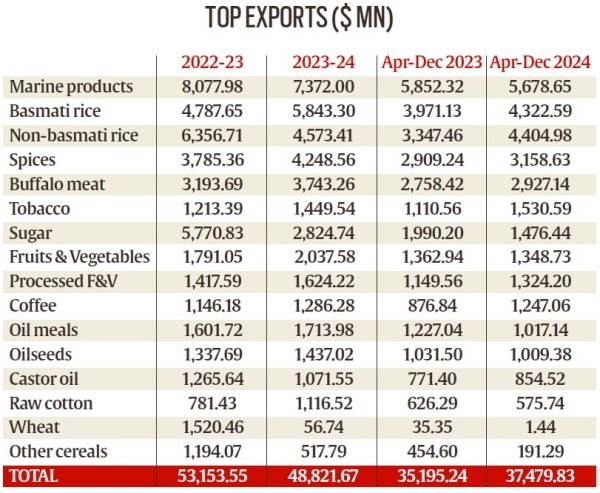
- Declined export of marine products - It has registered a drop from $7.8 billion in 2021-22 and $8.1 billion in 2022-23 to $7.4 billion in 2023-24.
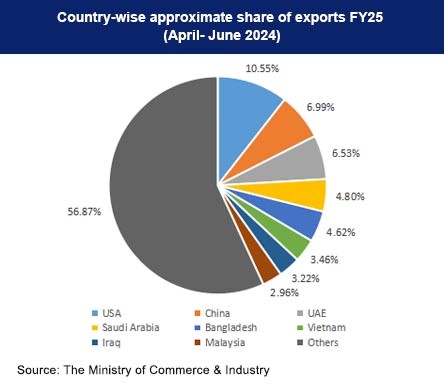
India’s marine exports — of which frozen shrimp accounts for roughly two-thirds — are mainly to the US (34.5% share in 2023-24), China (19.6%), and the European Union (14%).
- Political change in destination countries – The conservative and import restrictive policies of new government in US can further hurt Indian seafood exports.
- Concerns over domestic availability – Sugar and wheat exports have also taken a hit due to government restrictions following concerns over domestic availability and food inflation.
Sugar exports more than halved from $5.8 billion in 2022-23 to $2.8 billion in 2023-24.
- High import - India’s agricultural imports are dominated by two commodities, Edible oils and pulses.
- Reduced pulse production – Reduction in domestic pulse production will make pulse import crossing $5 billion for the first time.
- International agri market volatility –Russia Ukraine wars drove up global edible oil prices which increased India’s import billing.
- Spices net import - In spices, India is both an exporter and an importer and in 2023-24 it was a net importer of these two traditional plantation spices.
India’s imports of pepper (34,028 tonnes) and cardamom (9,084 tonnes) exceeded its corresponding exports of 17,890 tonnes and 7,449 tonnes.
- Collapse in cotton export – India’s cotton exports decline from $4.3 billion in 2011-12 to $781.4 million in 2022-23 and $1.1 billion in 2023-24.
India is the largest producer of cotton globally, accounts for 23% of total global cotton production and in 2022, India stood as the third-highest exporter of raw cotton globally, accounting for about 11% of the total global exports.
What lies ahead?
- Encourage the export of value-added agricultural products like processed foods, spices, and organic produce.
- Ensure a stable trade environment to encourage farmers to respond to market signals with confidence, redirecting resources towards high-return products.
- Avoid export restrictions on processed and organic products unless absolutely necessary for food security.
Reference
Indian Express | Shrinking agricultural trade surplus



